Maritime Nuclear: a strategic interest
Global maritime transportation has relied for a century on a single variable of cost and dependency: the barrel. The convergence of three forces — persistent fuel price volatility, the growing militarization of strategic maritime chokepoints, and the strong return of public programs for nuclear naval propulsion — is repositioning nuclear propulsion from a military niche to a credible commercial option.
Economics: a Small Modular Reactor (SMR) core can eliminate most of the vessel’s lifetime fuel costs, at the cost of a higher initial investment.
Geopolitics: nuclear reduces exposure to the Straits of Hormuz and Malacca, through which a major share of global energy flows transit. It also eliminates the need for regular refueling in ports and reduces exposure to variations in fuel quality.
Strategic independence: the MARAD program (2026) and the MARAD–CORE POWER agreement anchor the revival of the U.S. naval nuclear industry.
Economics: the end of dependence on heavy fuel oil
The price of Very Low Sulfur Fuel Oil (VLSFO) rose from an average of $518/tonne in February 2026 to $901/tonne between March and May, a 74% increase driven by the conflict with Iran [1-2]. This volatility illustrates the structural risk faced by any shipowner whose operating costs are 40–60% dependent on oil prices.
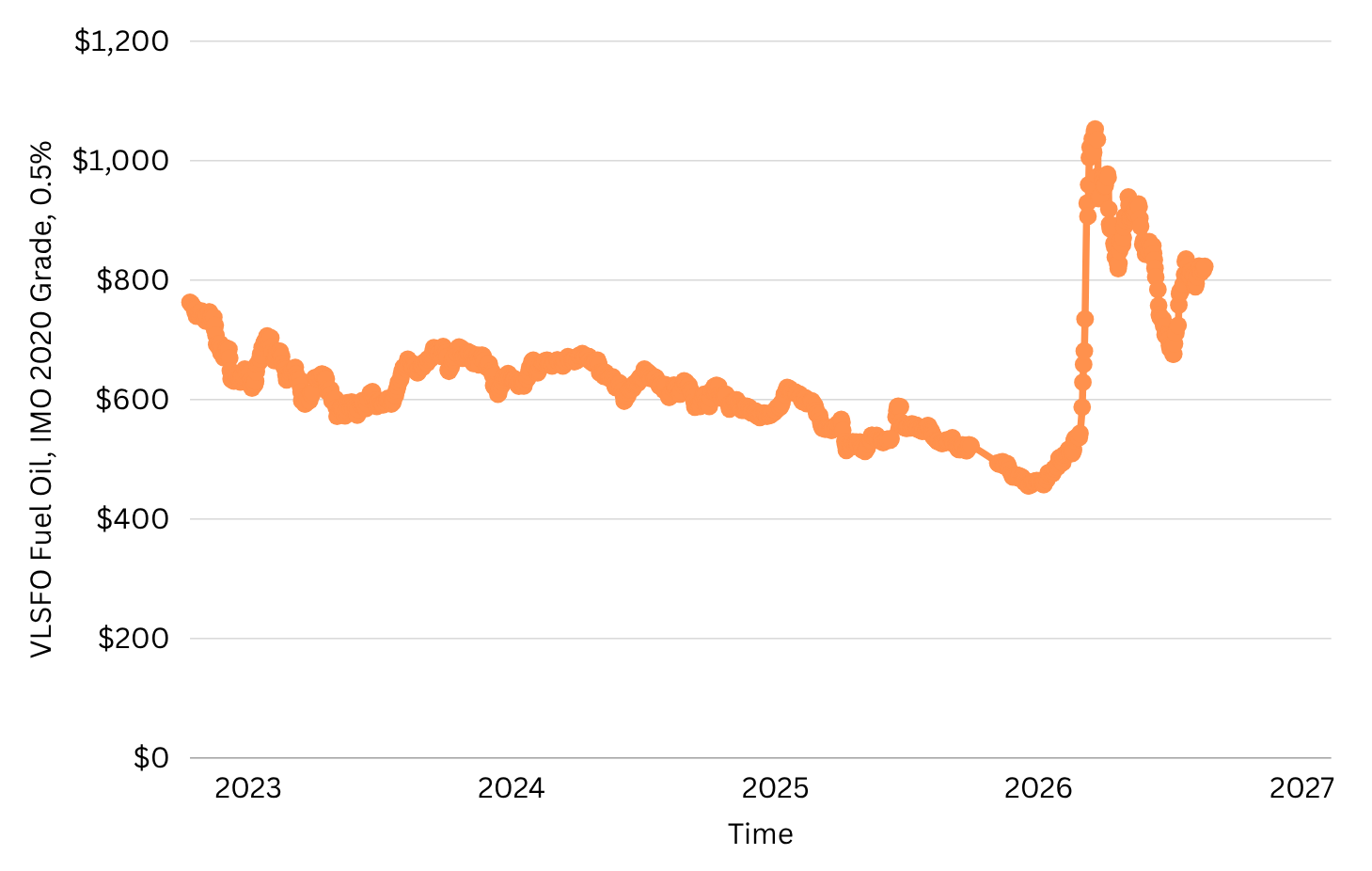
Figure 1: Average daily bunker fuel prices, as reported by Ship & Bunker and published by the U.S. Department of Agriculture (USDA).
For a large container vessel, annual VLSFO fuel costs can reach tens of millions of dollars [3]. A nuclear reactor using Low-Enriched Uranium (LEU) or High-Assay Low-Enriched Uranium (HALEU), with a potential refueling interval of 20–25 years [4], can substantially reduce exposure to fuel costs and price volatility once the initial investment is amortized. Nuclear propulsion therefore shifts expenditure from a variable and volatile cost—fuel—to a more fixed and predictable cost structure based on capital investment and maintenance.
Geopolitics: moving beyond maritime chokepoints.
A significant share of global oil and gas trade transits through a limited number of strategic maritime chokepoints [5] — Hormuz, Malacca, Suez, and Panama — where closure, blockade, or even heightened tensions can trigger sharp increases in freight rates and insurance premiums. Heavy fuel oil makes each vessel, and therefore each supply chain, vulnerable to this geography.
A nuclear-powered vessel does not structurally require fossil-fuel refueling throughout the lifetime of its reactor core. This autonomy decouples maritime logistics from the geopolitics of oil routes and removes a source of economic pressure for states or actors controlling these strategic passages. It also reduces the need for regular bunkering in ports, limiting exposure to port availability, fuel supply disruptions, and variations in fuel quality.
The uranium fuel supply chain is also subject to geopolitical dependencies (see Nuclear Supply Chain discussion). However, recent U.S. policy measures aim to reduce this dependence and strengthen the resilience of the domestic nuclear fuel supply chain. This is why the nuclear industry is critical to strategic independence.
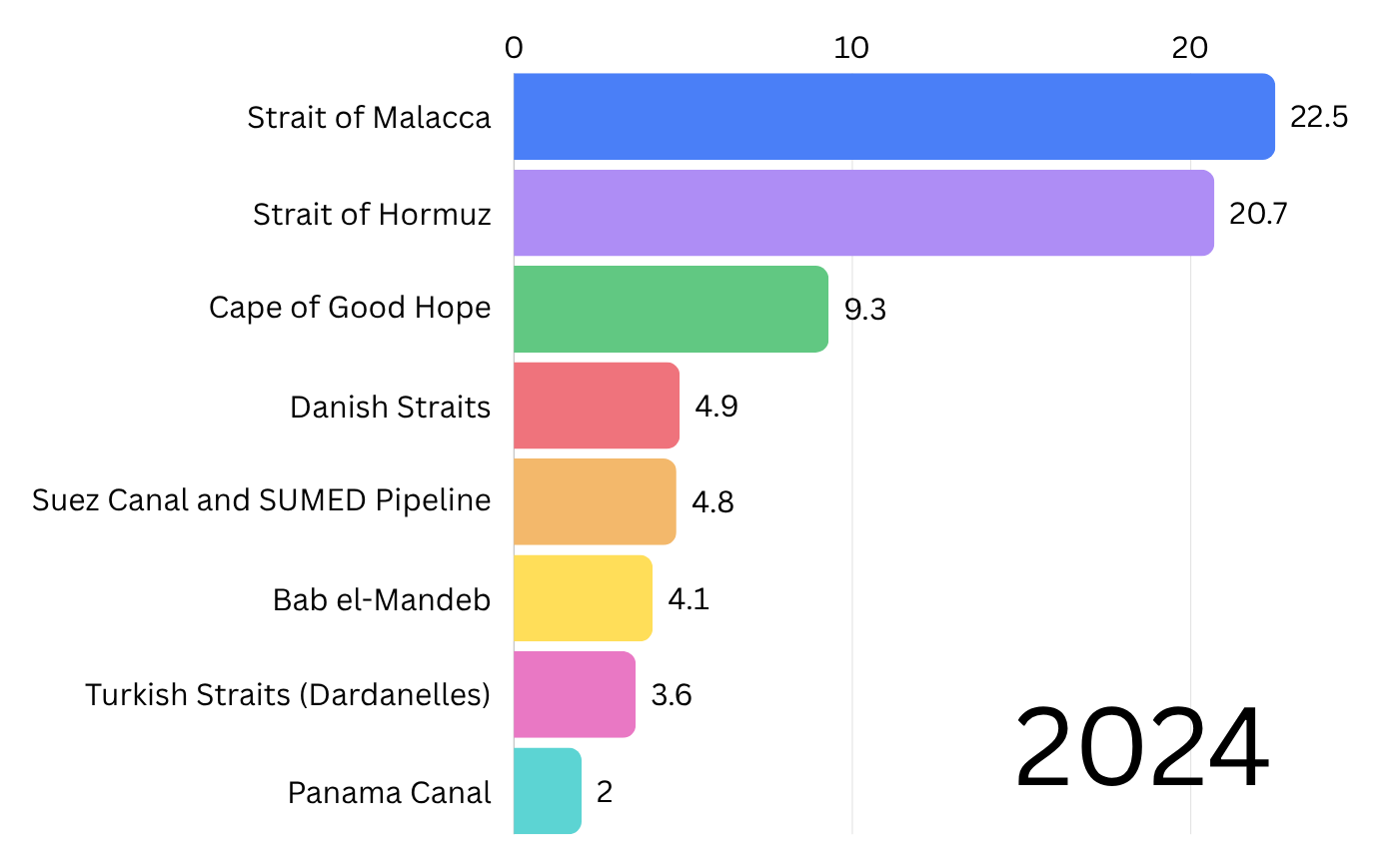
Figure 2: Volume of crude oil and petroleum liquids transported through world chokepoints in 2024 published by the U.S. Department of Energy (million barrels per day).
Strategic Independence: The U.S. Regulatory Momentum
In May 2026, the U.S. Department of Transportation (DOT) and the Maritime Administration (MARAD) launched a dedicated initiative on small modular reactors (SMRs) for commercial shipping through a Request for Information (RFI), calling on industry to propose a replicable SMR design for the U.S. fleet [6]. The stated objective combines operational efficiency, cost reduction, and national energy security.
In August 2026, MARAD and CORE POWER signed a memorandum of cooperation to establish the commercial, industrial, and regulatory framework for a future U.S.-flagged nuclear-powered merchant fleet, with the objective of beginning construction as early as 2028 [7]. This agreement follows similar partnerships with the Ports of Long Beach and Corpus Christi, positioning U.S. port infrastructure to support the development of nuclear-powered shipping as China is also advancing its own nuclear merchant vessel concepts.
This momentum builds on the presidential executive order “Restoring America’s Maritime Dominance” and the Maritime Action Plan issued in February 2026 [8-9], which explicitly identify marine nuclear power as a pillar of U.S. industrial and energy revitalization.
What Naval Operations Have Already Demonstrated
Naval nuclear power is not a hypothesis: the U.S. Navy has more than seventy years of experience operating shipboard reactors. Nimitz-class carriers use two PWRs with only one mid-life refueling, while the Gerald R. Ford class features life-of-ship reactor cores. France has also developed extensive naval nuclear expertise through the Charles de Gaulle aircraft carrier and its ballistic-missile and attack submarines.
On the civilian side, Russia has operated a fleet of nuclear-powered icebreakers since the 1950s under the Rosatom program. Today, this represents the only large-scale operational segment of commercial nuclear shipping in the world, demonstrating the long-term industrial viability and maintainability of these platforms, including their integration with port infrastructure.
This body of military and polar operational experience provides a critical technical foundation for organizations such as Stratomic seeking to support the transition to commercial nuclear shipping, particularly in areas such as reactor safety, spent-fuel management, crew training, and interfaces with port and maritime authorities.
International Legal Framework for Naval Nuclear Power
The safety of nuclear-powered ships is regulated at the international level through Chapter VIII of the 1974 SOLAS Convention, which establishes basic requirements to address radiological risks, complemented by the Code of Safety for Nuclear Merchant Ships (Resolution A.491(XII)), adopted by the IMO Assembly in 1981 [10].
The International Maritime Organization, with support from the IAEA, has initiated a revision of this framework. The IMO’s Sub-Committee on Ship Design and Construction (SDC) has established a roadmap toward the adoption of a revised Nuclear Ship Safety Code and amendments to SOLAS Chapter VIII by around 2030. The revised framework is intended to be based on performance-based objectives rather than prescriptive requirements limited to PWR technology.
In addition, nuclear shipping is subject to the broader non-proliferation framework. Any civilian nuclear-powered shipping program must operate within the scope of IAEA safeguards and the Treaty on the Non-Proliferation of Nuclear Weapons (NPT), which govern the use, enrichment, transport, and eventual disposition of nuclear material. The U.S. regulator has explicitly incorporated these considerations into the 2026 MARAD RFI by requesting proposals addressing the regulatory and statutory revisions required to enable commercial nuclear-powered shipping [11].
Maritime nuclear power could become a critical component of the U.S. nuclear renaissance opening the door to a significant new economic market. This approach could strengthen strategic and geopolitical independence, enhance economic resilience, and provide a low-carbon propulsion option for commercial shipping.
However, the nuclear renaissance is not a simple reactor design. The supply chain will be a key element of the sector’s success. Nuclear security and safety are non-negotiable and will require rigorous oversight within a new international and national regulatory framework.
References
[1] F. Leibovici and D. Chinagorom-Abiakalam, “Oil Prices and Container Shipping Costs,” Federal Reserve Bank of St. Louis, On the Economy, July 17, 2026.
[2] U.S. Department of Agriculture, “Daily Bunker Fuel Prices,” Open Ag Transport Data, Agricultural Marketing Service, August 20, 2026.
[3] CE Delft, Fleet-level compliance with the CII Regulation: A Total Cost of Ownership analysis, May 2021, p. 26.
[4] International Atomic Energy Agency, Advances in Small Modular Reactor Technology Developments, Vienna, Austria: IAEA, 2020.
[5] U.S. Energy Information Administration (EIA), “World oil transit chokepoints,” U.S. Department of Energy, 2025.
[6] U.S. Department of Transportation, “Trump’s Transportation Secretary Sean P. Duffy Launches Small Modular Nuclear Reactors Initiative to Drive Down Costs for U.S. Shipping, Enhance Energy Dominance,” May 7, 2026. U.S. Department of Transportation.
[7] CORE POWER, “Turning policy into steel. Turning vision into ships,” Aug. 24, 2026. CORE POWER.
[8] The White House, “Restoring America’s Maritime Dominance,” Executive Order 14269, Apr. 9, 2025.
[9] The White House, “Restoring America’s Maritime Dominance,” Maritime Action Plan, Feb. 13, 2026.
[10] International Maritime Organization (IMO), “Code of Safety for Nuclear Merchant Ships,” Res. A.491(XII), 1981.
[11] International Maritime Organization (IMO), “Safety and environmental aspects of nuclear-powered ships,” Sub-Committee on Ship Design and Construction (SDC), roadmap for the development of a revised nuclear ship safety code and amendments to SOLAS Chapter VIII, 2025–2026.