Cosmic Radiation in Space Nuclear Design
Any nuclear system deployed in space faces two radiation sources at once: the one it generates, and the one the universe imposes on it.
The first source is modeled and controlled: the nuclear core itself.
The second source is imposed by the space environment: Galactic Cosmic Rays, Solar Energetic Particles, and trapped belt particles. These high-energy particles interact with spacecraft materials and shielding, and they cannot be practically eliminated without a prohibitive mass penalty [1-2].
Cosmic radiation cannot be treated as a late-stage design detail. It determines which electronics can survive the mission, what shielding is feasible within the mass budget, and which failure modes must be addressed from day one.
Three Sources That Matter
Galactic Cosmic Rays (GCRs) are fully ionized nuclei, composed mainly of protons, with smaller fractions of helium nuclei and heavy ions. Although the heavy-ion component is small in flux, it can be strongly damaging per particle because of its dense energy deposition. Their energy spectrum is dominated by particles in the giga-electronvolt (GeV) range.
Solar Energetic Particles (SEPs) are made of protons from tens to hundreds of MeV, creating immediate risks for latch-up, power electronics failures, and sensor degradation [3].
Trapped belt particles (Van Allen belts) are a major hazard for Earth-orbit and lunar-transfer architectures. The inner Van Allen belt contains energetic protons reaching hundreds of mega-electronvolt (MeV), which can drive dose and displacement damage in solar cells, sensors, and semiconductor electronics [4].
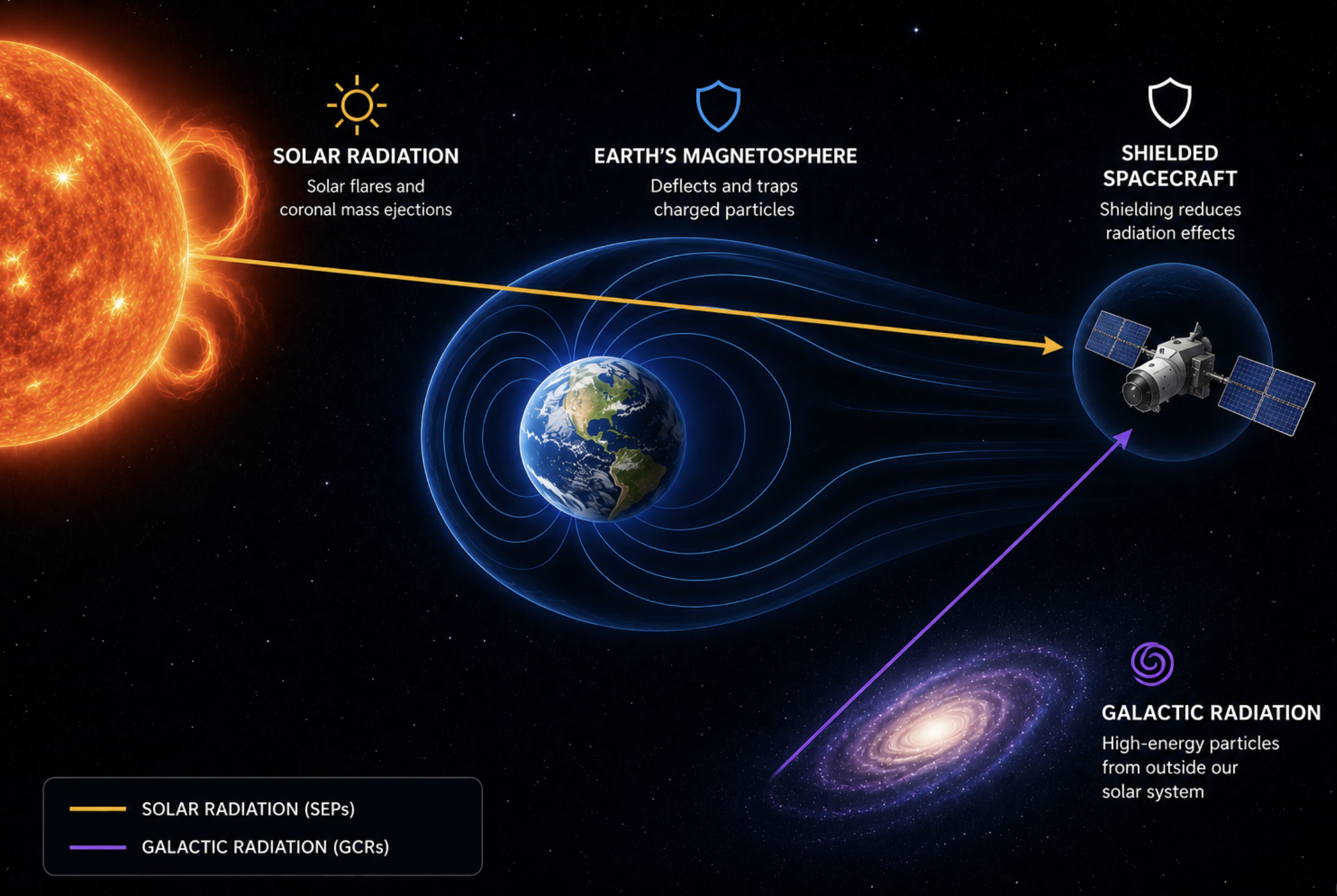
Figure 1: Simplified view of solar and galactic radiation environments relevant to space systems.
Why Space Radiation Matters More for Nuclear Systems
Radiation matters for every spacecraft. But it matters even more for space nuclear systems because they operate between two radiation sources at the same time.
The first source is internal: the nuclear core. It produces radiation that must be managed through shielding, distance, geometry, material selection, and system layout.
The second source is external and imposed by the space environment. It is variable and difficult to predict. These particles arrive from outside the system, interact with spacecraft materials and shielding, and cannot be fully eliminated.
This dual radiation environment is what makes space nuclear design unique. A conventional spacecraft mainly needs to survive external radiation. A space nuclear system must survive external radiation while also controlling the radiation it generates.
This affects three critical areas.
First, it affects electronics. Reactor radiation and cosmic rays can both contribute to the total ionizing dose. In a space nuclear system, an electronics failure can become a mission-level issue if it affects reactor control, power conversion, heat rejection, or autonomous safety logic.
Second, it affects humans. For crewed missions, radiation protection must account for both the space environment and the onboard nuclear source. Shielding must therefore protect the crew from reactor radiation while also reducing exposure to cosmic particle events. For instance, during a three-year Mars mission, the cumulative dose from space radiation could approach 1 Sv [5].
Third, it affects structural materials. Radiation can degrade semiconductors, sensors, insulators, optical materials, polymers, and power conversion components. It can also create secondary particles when high-energy radiation interacts with shielding. This means shielding is not simply a matter of adding mass; it must be optimized for the full radiation environment.
For space nuclear systems, radiation protection is therefore not only a safety issue. It is a design issue. It determines where the core is placed, where electronics can survive, how the shield is shaped, what materials can be used, what dose the crew can receive, and how reliable the system can remain over the mission lifetime.
Stratomic helps organizations assess nuclear-sector risks, identify strategic dependencies, and translate technical complexity into actionable decisions.
Stratomic. Where nuclear expertise meets strategic vision.
References
[1] J. L. Barth, C. S. Dyer, and E. G. Stassinopoulos, “Space, atmospheric, and terrestrial radiation environments,” IEEE Transactions on Nuclear Science, vol. 50, no. 3, pp. 466–482, Jun. 2003.
[2] D. Maurin et al., “Precision cross-sections for advancing cosmic-ray physics and other applications: A comprehensive programme for the next decade,” Physics Reports, vol. 1161, pp. 1–81, 2026, doi: 10.1016/j.physrep.2025.11.002.
[3] K. Whitman et al., “Review of solar energetic particle models,” Advances in Space Research, vol. 72, no. 12, pp. 5161–5242, Dec. 2023, doi: 10.1016/j.asr.2022.08.006.
[4] G. P. Ginet et al., “AE9, AP9 and SPM: New models for specifying the trapped energetic particle and space plasma environment,” Space Science Reviews, vol. 179, pp. 579–615, 2013, doi: 10.1007/s11214-013-9964-y.
[5] F. A. Cucinotta and M. Durante, “Cancer risk from exposure to galactic cosmic rays: implications for space exploration by human beings,” The Lancet Oncology, vol. 7, no. 5, pp. 431–435, May 2006, doi: 10.1016/S1470-2045(06)70695-7.